

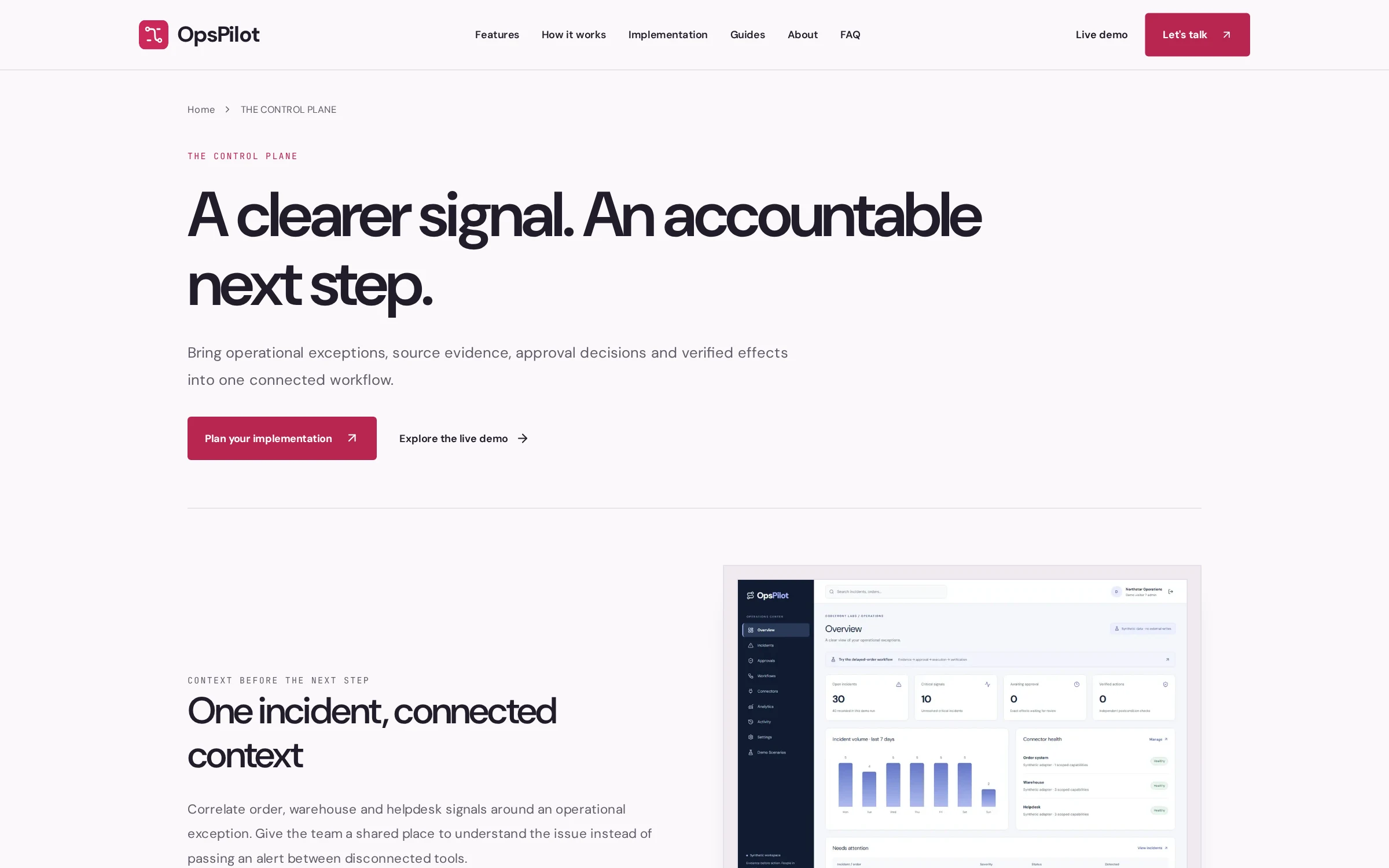
A closer look at OpsPilot.
OpsPilot gives an operations team a traceable path from a business-system exception to a verified action. It is available through a direct implementation engagement with Codefront Labs, rather than self-service subscriptions. The interactive demo creates an isolated organization with synthetic operational records. Visitors can run a delayed-order scenario, inspect evidence, approve a warehouse task, reject a customer draft, and verify that only the approved effect occurred. Hosting, connectors, access policy and support are scoped for each implementation.
The challenge
An overdue order can look different in an order system, a warehouse record and a customer conversation. Connecting those signals is only the first step: teams still need to establish what is known, decide which change is appropriate, authorize it precisely and confirm what actually happened. An AI recommendation cannot serve as its own authorization or evidence of success.
The product experience
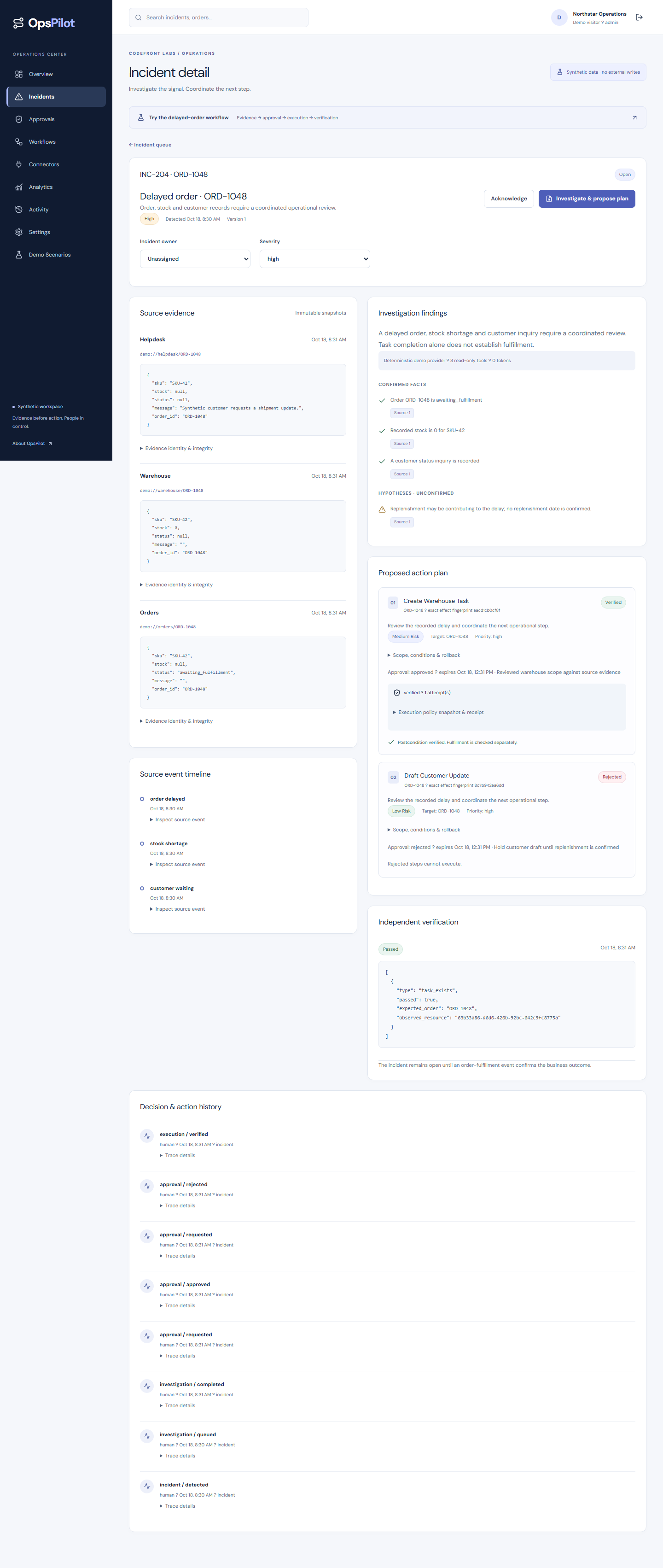
Typed events are deduplicated and correlated into incidents. Scoped read-only tools persist hashed evidence snapshots before analysis separates facts from hypotheses and proposes a typed plan. Each step exposes its target, arguments, risk, preconditions, expected result and rollback guidance. A person approves or rejects that exact effect. The deterministic worker rechecks current permissions, policy, approval expiry and source state, applies an idempotent synthetic effect, and independently reads it back. A verified task leaves the incident open until a fulfillment event confirms the business outcome.
- A working exception-to-verified-effect loop with persistent data, a private synthetic demo, per-step decisions and a complete audit trail.
- Automated checks cover tenant isolation, approval expiry, permission and policy changes, signed webhook replay, immutable records, concurrent idempotency, bounded retry and failed verification.
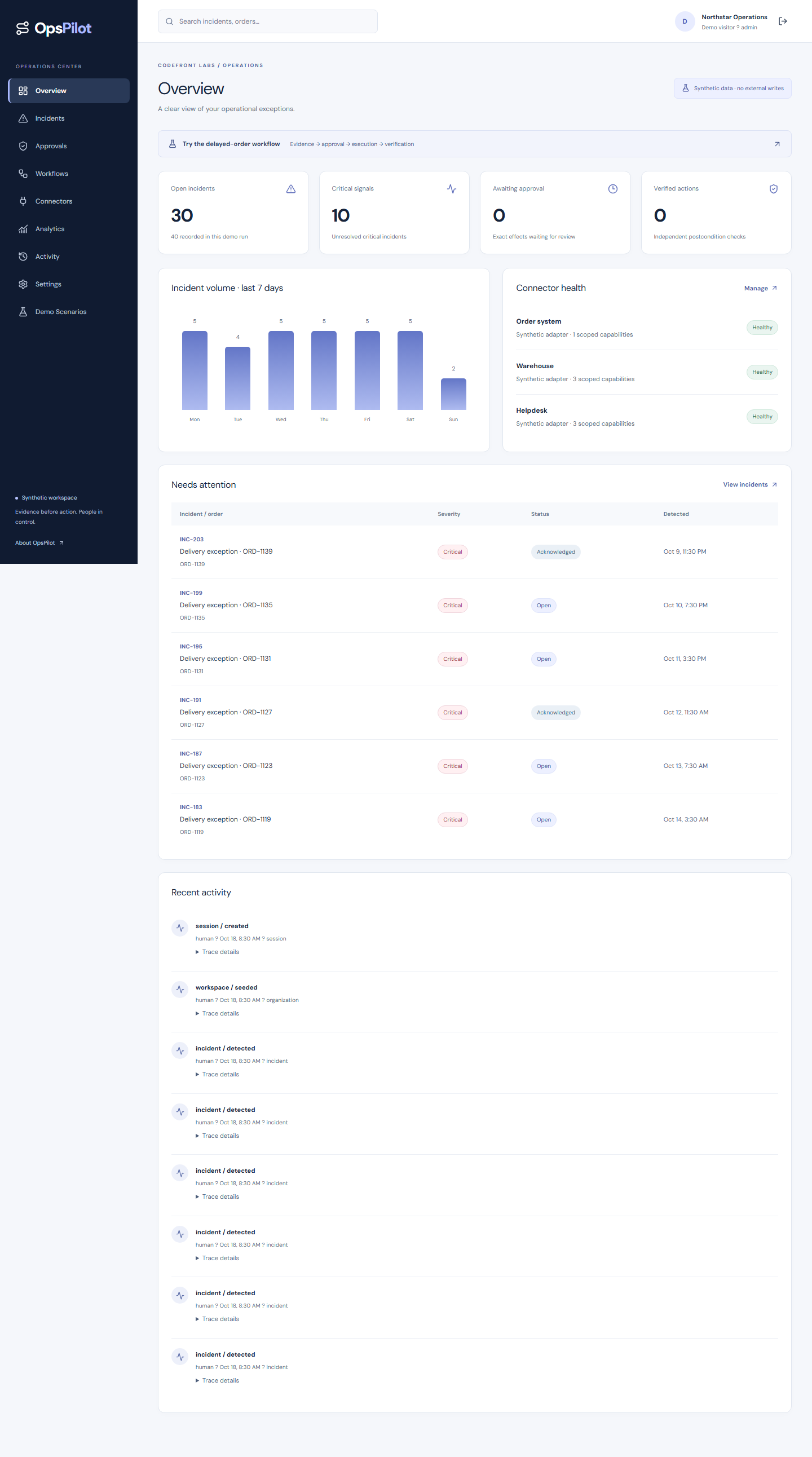
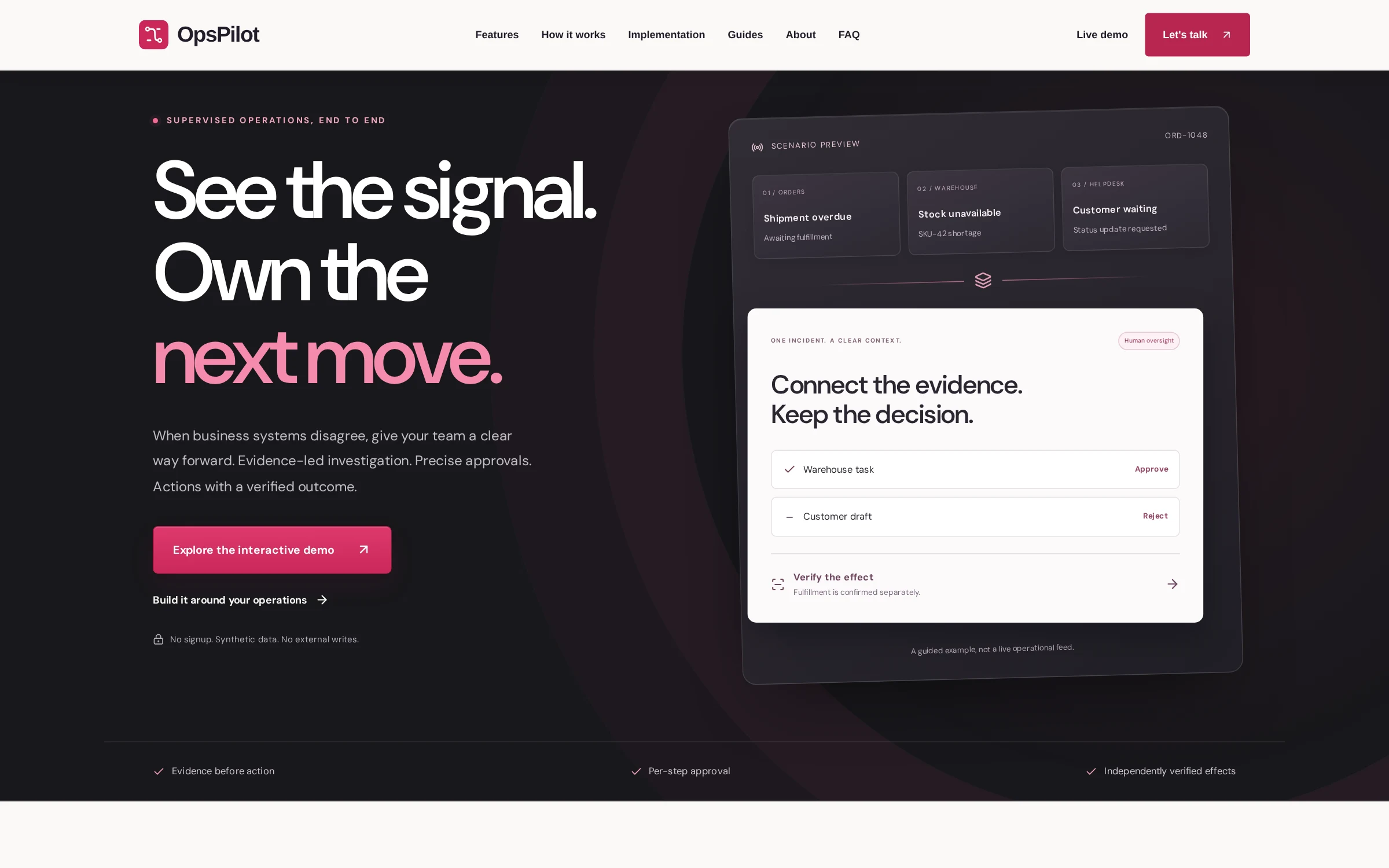
- Ten functional screens, a custom product landing page, responsive layouts and browser accessibility checks. No invented client identity, business savings or production outcomes are claimed.
Product & engineering
Next.js, TypeScript, Tailwind and TanStack Query provide a persistent workspace shell behind a same-origin API proxy. FastAPI enforces revocable HttpOnly sessions, CSRF, roles and tenant-scoped references. PostgreSQL stores incidents, evidence, per-step approvals, effects, jobs and immutable audit history. A transactional outbox dispatches durable work through Redis/Celery; database locks and unique effect keys guard concurrent retries. The synthetic connectors expose only registered capabilities. Provider context is bounded and structured output is schema-, citation- and target-validated. The Docker backend and dedicated Linux Cloudflare tunnel are separate from the Vercel frontend.
The decisions that shape the work
Interpretation is separate from authority
AI can organize evidence and propose a plan. Deterministic server code owns permissions, policy, approval and execution.
Approve one effect, not a whole intention
Each step has a fingerprint and an expiring decision. Approving the warehouse task never approves the neighboring customer draft.
A receipt is not a verified outcome
The worker reads back the stored connector effect and checks its postcondition. Failed verification is visible, auditable and escalated.
Task completion does not prove fulfillment
The incident remains open after a verified escalation task. A separate source event confirms the order was fulfilled.
Working within the constraints
- All public demo records and connector effects are synthetic. The demo never sends external messages or changes a production system.
- The public demo uses a deterministic provider. A separate business workspace can use a configured OpenAI-compatible provider with validated output; model-quality or customer performance claims are not made.
- Approvals apply to exact individual steps. Rejected or expired actions cannot execute, and high-risk decisions require an independent manager or administrator.
- Production ERP/email adapters, enterprise SSO, billing, automatic compensation and scheduled off-host backups require separately agreed implementation work.
Have a similar challenge?
For teams that need operational automation adapted to their evidence sources, responsibilities, approval boundaries and existing systems.
Talk about your project