


A closer look at Bidwright.
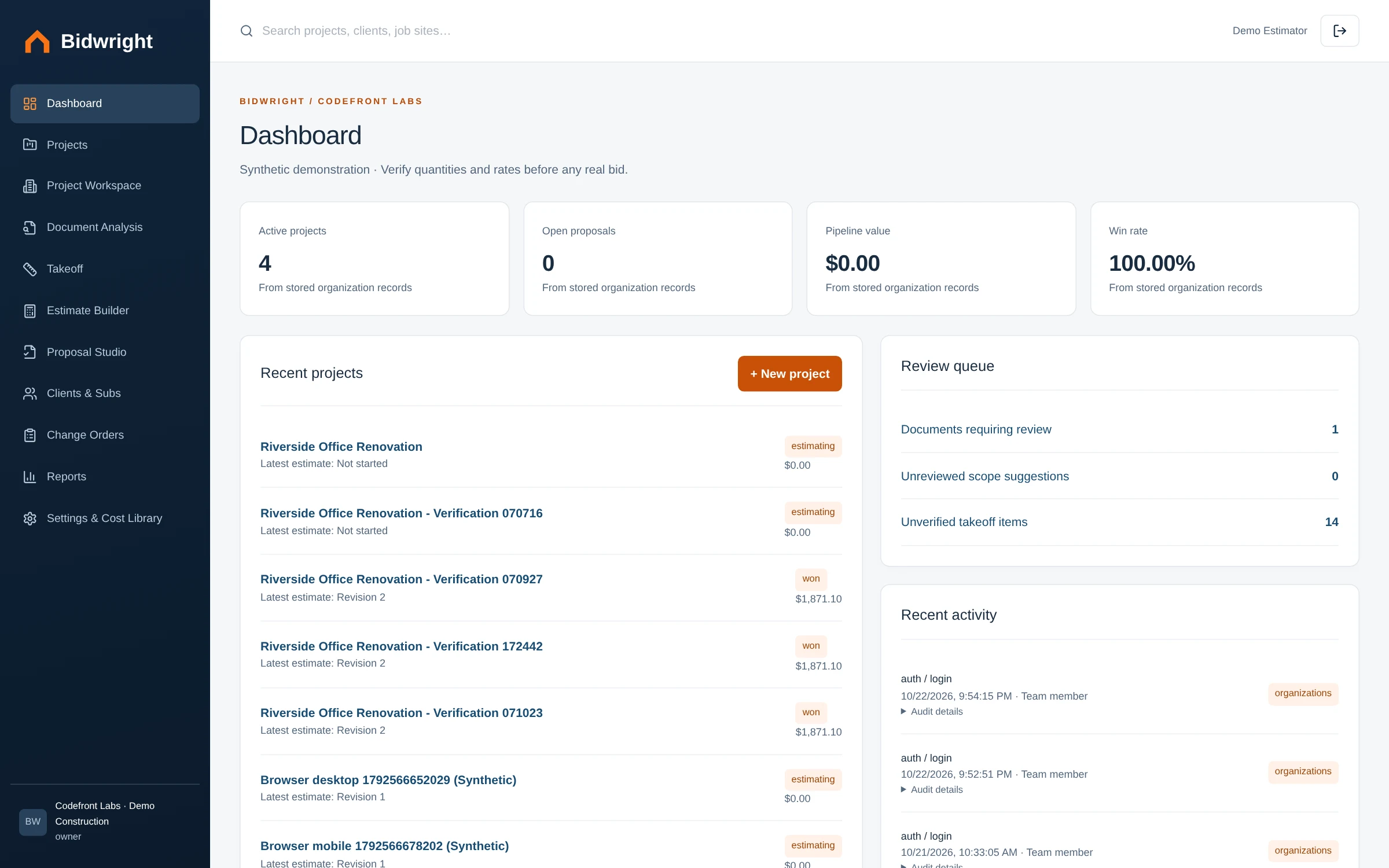
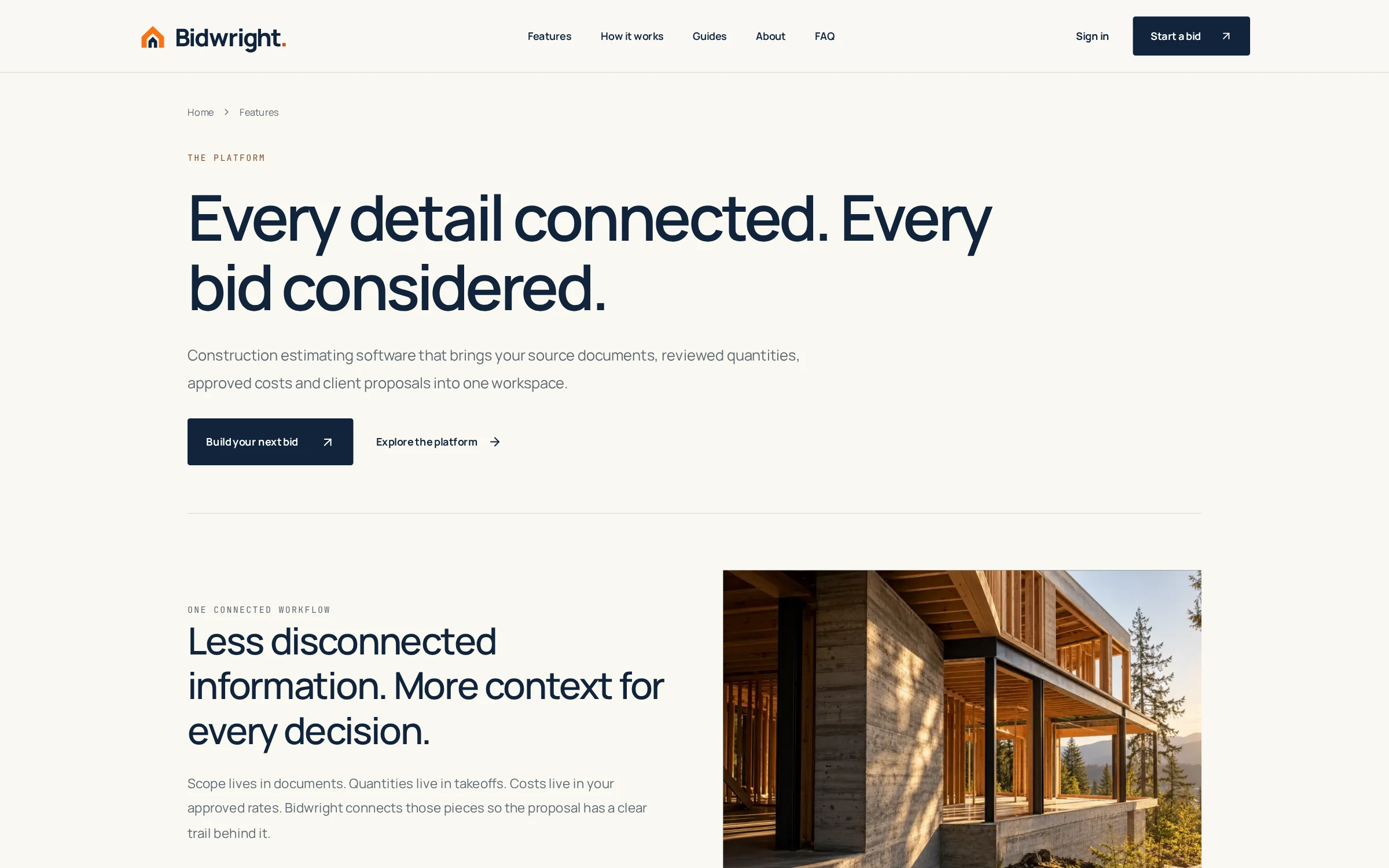
Bidwright connects a contractor's project scope, document review, takeoff, cost library, estimate, proposal, and change orders in one persistent workspace. The public website introduces the workflow; contractors can create an organization for their own records. Its illustrative landing-page figures use synthetic quantities and rates, rather than customer results or market prices.
The challenge
An estimate needs more than extracted text and a plausible total. Contractors must establish quantities, source current costs, distinguish markup from margin, review assumptions, and preserve what was actually approved when a proposal changes.
The product experience
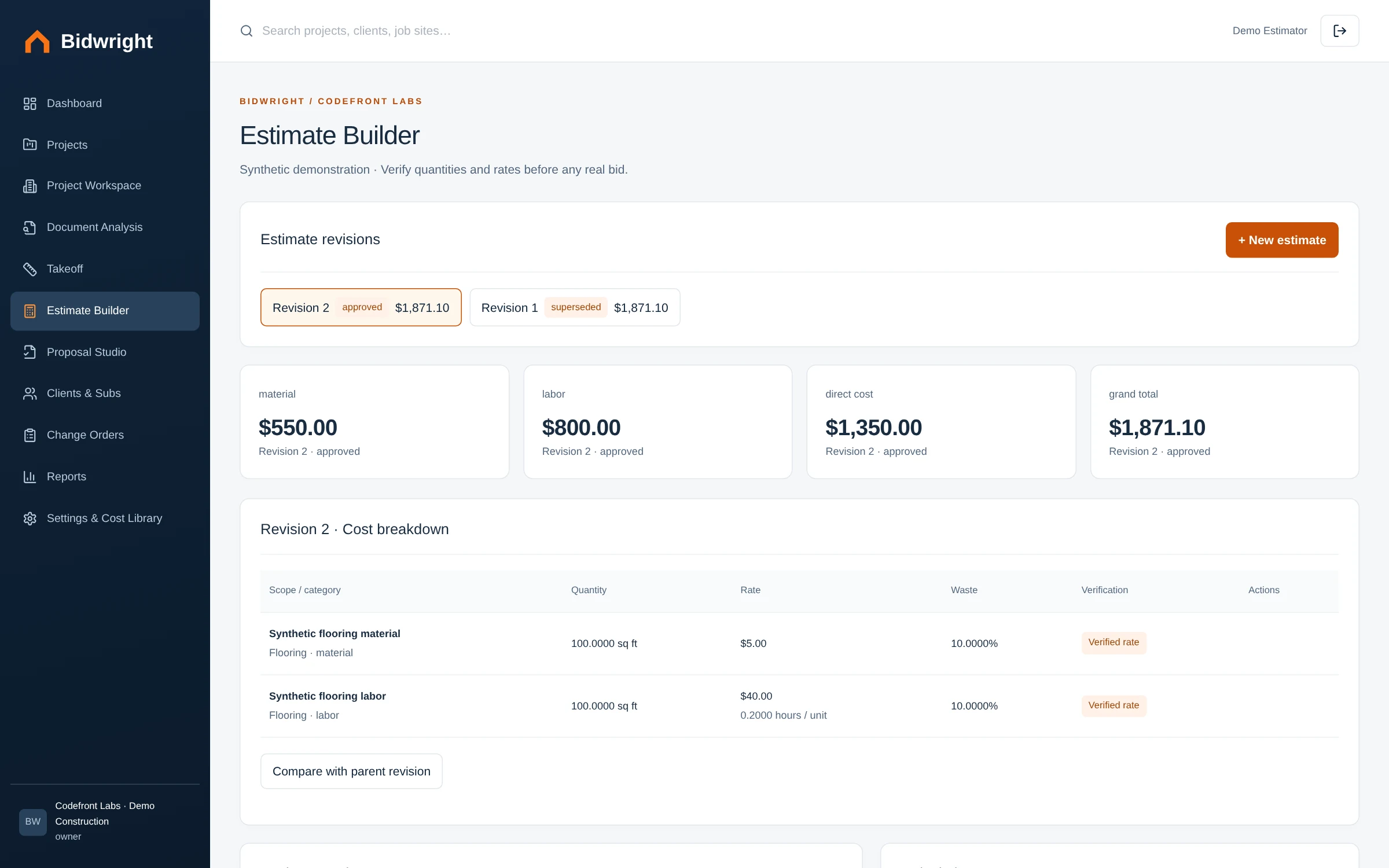
Uploaded scope documents are stored privately with immutable source hashes. Suggested items retain citations and accept, edit, or reject decisions before becoming editable takeoff. Verified measurements and sourced rates feed a deterministic estimate engine. Reviewed estimates produce versioned PDF proposals; revisions and change orders preserve the original financial baseline and its audit trail.
- A persistent workflow spanning projects, scope documents, reviewed takeoff, sourced costs, estimates, proposals, and change orders.
- Versioned financial snapshots, private document storage, organization-scoped access, and auditable review decisions.
- A public product introduction and responsive application. No customer savings, adoption figures, or commercial outcomes are claimed.
Product & engineering
A Next.js and TypeScript frontend uses TanStack Query and validated forms behind a same-origin API proxy. FastAPI, SQLAlchemy, and PostgreSQL own organization-scoped data, roles, version checks, and immutable financial records. Redis-backed RQ workers perform bounded document extraction, OCR, and optional AI analysis. Private MinIO storage retains source documents and PDFs. Decimal calculations and reconciled cent rounding remain separate from AI interpretation. The Vercel frontend connects to an isolated Docker backend on the Linux host.
The decisions that shape the work
AI suggests; people verify
Source-backed suggestions retain their original evidence and reviewer decisions. Accepted scope still requires explicit quantity verification.
Financial math stays deterministic
Currency-safe calculations handle material waste, labor conversions, tax, markup, margin, and cent reconciliation without asking a language model to invent prices.
Approval preserves a baseline
Published proposals retain their approved snapshot and PDF. Revisions and change orders record subsequent changes without rewriting the original agreement.
Working within the constraints
- AI suggestions require source evidence and human review. Unknown quantities and missing or unverified prices cannot silently become trusted estimate inputs.
- The public workflow and demonstration prices are synthetic. Contractors supply and verify their own costs before commercial use.
- Client decisions are recorded manually. Automatic email delivery, e-signatures, payments, accounting integrations, and automatic drawing measurements are outside the documented implementation.
- External AI processing requires a configured provider and explicit organization consent; local fixture mode does not fabricate analysis for arbitrary uploads.
Have a similar challenge?
For contractors and construction teams that need traceable estimating workflows shaped around their scope, rates, review process, and proposal requirements.
Talk about your project