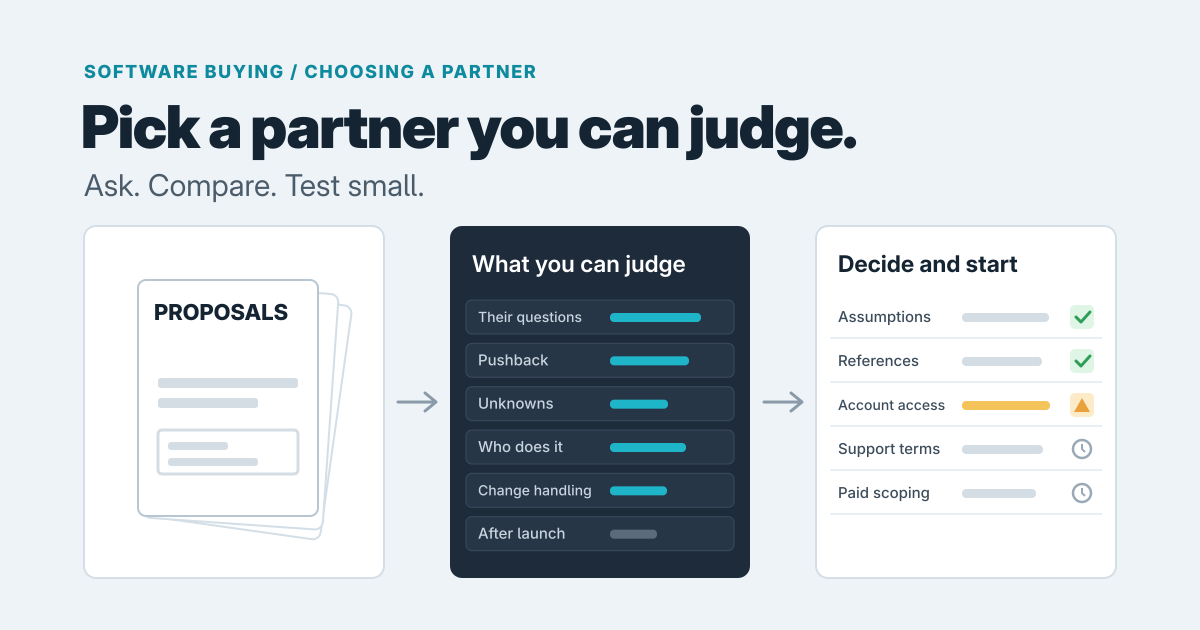
Pick the team that understands your problem best, not the one with the longest feature list or the lowest number. You can't judge the code, and you don't need to. What you can judge is how a team thinks, how it talks to you, and what it's willing to put in writing. Those things tell you more about how the project will go than a portfolio does.
What you can judge without technical skill
Start with the questions they ask. A good team spends the first call on your business: who does this work today, where it goes wrong, what happens when an exception shows up, what a good outcome looks like in six months. A weak one jumps to screens and features within ten minutes. If they haven't asked what you do now, they're pricing a guess.
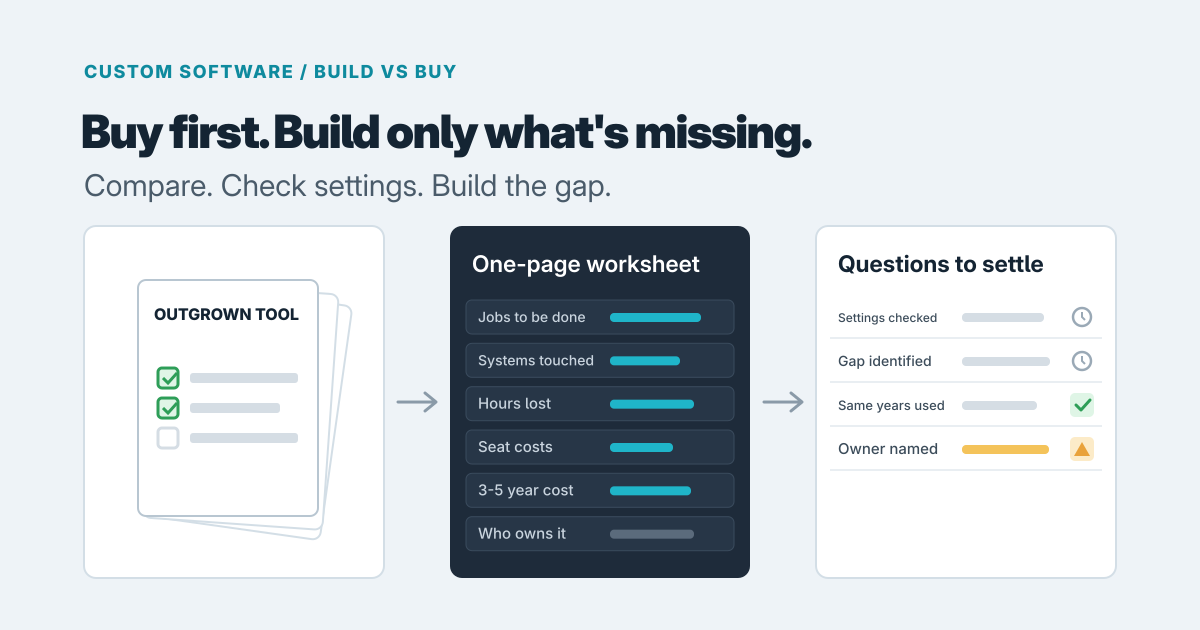
Next, listen for pushback. Ask whether any part of your wish list should wait, or whether an existing tool could cover some of it. A team that says yes to everything is either not thinking or not being straight with you. A team that says "buy that part, build this part" is working for your outcome. Our piece on custom software versus off the shelf shows the sort of answer you should hope to hear.
Then test how they handle unknowns. Every project has some. Ask what they're least sure about and how they'd find out. Good answers sound like "we don't know how clean your data is, so we'd look at a sample first." Bad answers sound like confident certainty about things nobody has seen yet.
Finally, ask them to explain one tradeoff in plain words. If you leave the call more confused than you arrived, that's information. Clear explanation is a skill, and you'll depend on it every week of the project.
Small studio, larger agency, freelancer or in-house hire
There's no reliable data on which type fails more often, so take this as judgment, not statistics.
A freelancer is often the cheapest and fastest to start, and you talk to the person doing the work. The risk is single-person dependence: illness, a new job or a full calendar can stall you, and nobody else knows your system.
A small studio usually gives you senior people on your project and direct access to them. The risk is capacity. Ask what happens if they're busy with another client when you need a fix.
A larger agency brings more people, more specialties and process. The risk is that the people who sell the work aren't the ones who do it, and small projects can get less attention than big accounts.
An in-house hire makes sense when you have steady, ongoing work. For one project it's slow and expensive, and one person rarely covers design, building and operations.
Pick based on what you can't afford to lose: speed, continuity, breadth or direct access.
Reading a proposal
Compare proposals on what's written beside the number. The US government's 18F team, which advises federal agencies on buying software, recommends weighing four things: technical approach, staffing, similar experience and price (18F field guide). That's public-sector guidance, and we use it for the principle: price is one of four factors, and that holds for a small business too.
Look for:
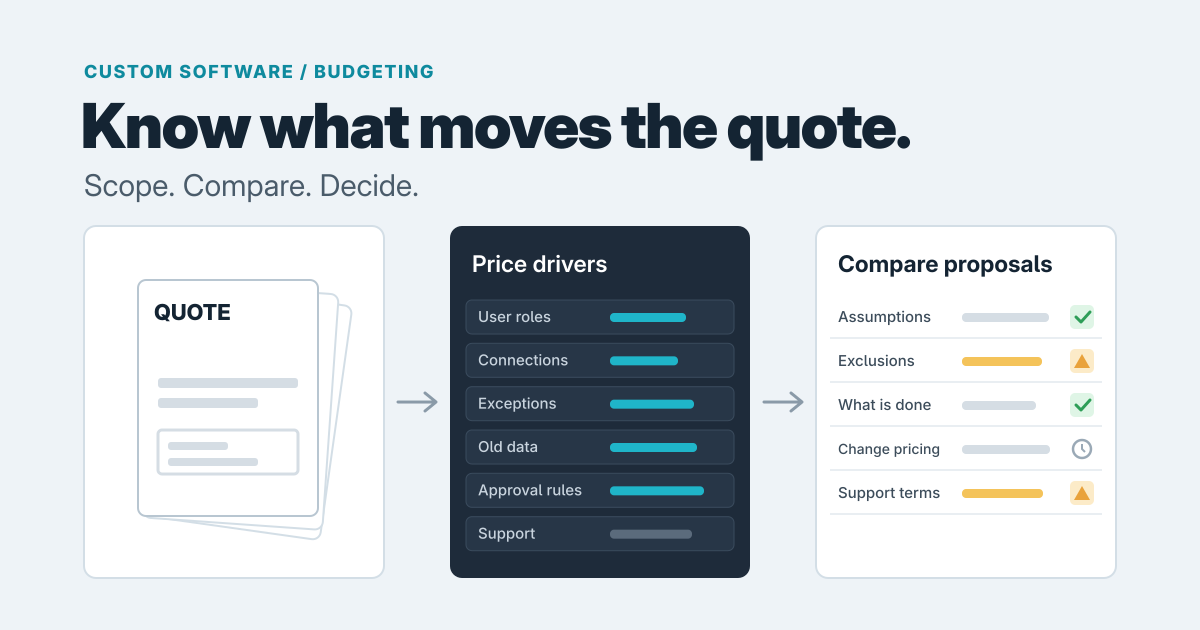
- Assumptions. What do they believe about your data, your users and your existing systems? Proposals that list none are hiding them. Our article on what drives the quote explains how to compare on assumptions.
- What's left out. Good proposals say what's not included. If two quotes differ by a lot, the gap is usually scope, not efficiency.
- How changes are handled. You will change your mind. Ask what that costs and how it's decided. Some teams work in short, repeated steps (often called agile), where you review working software as it's built and adjust the plan as you learn. Others quote a fixed scope up front and charge change orders, meaning paid add-ons to the original agreement, for anything new. Both can be legitimate. The 18F handbook flags a mismatch as a red flag: a vendor describing the flexible, step-by-step approach while billing through change orders (18F technology budgeting handbook). The problem isn't change orders on genuinely fixed work. It's saying one thing and billing another.
- Who you'll work with. Ask for names and roles. Ask who you'll talk to weekly, and whether the people on the sales call are the people building.
- How often you see working software. Ask how often you'll get to review something real, not a slide deck. UK government guidance on contracting for this kind of step-by-step work notes that regular touch points allow feedback and a change in approach (UK government guidance).
Reference calls and past work
A polished portfolio shows what shipped, not how it felt. It rarely shows the project that ran late, the scope fight or the quiet months after launch. So call two past clients, ideally one whose project didn't go perfectly. Ask:
- What surprised you, and how did they handle it?
- Did the person you met at the start stay on the project?
- What happened when something broke after launch?
- Would you hire them again for something bigger?
Also ask for work similar to yours in kind, not just in industry. A team that has built a customer portal tells you more than one that has built a pretty marketing site.
What happens after launch
Most owners ask about this too late. Before you sign, get plain answers to:
- Who holds the accounts that keep your software running, such as the company that hosts it (the computers it runs on), the registration of your web address, and any paid outside services it uses? Ask that these be set up in your name, with the studio added as a user, so you aren't locked out if you part ways.
- Will you receive the finished code, plus a written explanation of how the system is put together and kept running?
- Is there a period after launch where defects are fixed at no charge? What counts as a defect? UK government guidance describes warranties that work is free from defects and of satisfactory quality, so asking what the studio stands behind is reasonable.
- What does ongoing support cost, and what response time can you expect?
- If you part ways, what would the handover look like, meaning the passing of your accounts, code and know-how to you or a new team?
The general aim, which public-sector guidance also states, is not being dependent on a single supplier. Our article on planning your vendor exit goes deeper. Ownership terms vary by contract, so have a lawyer read yours.
What to have ready before the first call
You'll get better proposals if you arrive with:
- A plain description of the job: who does it today, what steps, where it hurts.
- A few real examples, including a messy one.
- The tools you already use and which must stay connected.
- A rough budget range and a date that matters, if there is one.
- Who decides, and who will use it.
If you haven't mapped the work yet, map the work first. It makes every conversation sharper.
A sensible first step, and when to walk away
Smaller is safer. The Standish Group's 2013 CHAOS Manifesto reports that small projects have a better chance of success than large ones (Standish 2013). Standish's surveys have drawn criticism for their methods, so treat that as a direction, not proof. The practical point holds anyway: you can't always make a project small, but you can make each release small.
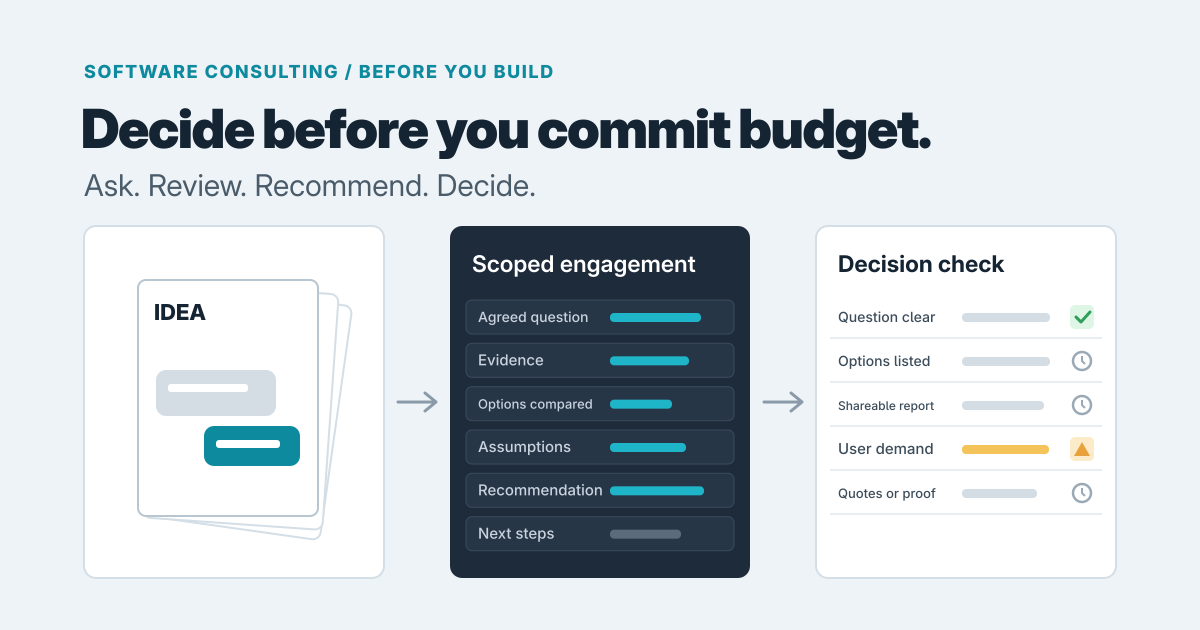
So don't start with a full build. Start with a paid scoping project, meaning a short, fixed-price piece of work where the team studies your process and tells you what to build, in what order and at what risk. Or ask for a small piece of real work. Government buyers use a similar idea, asking vendors to show working results rather than extensive paperwork (18F modular procurement). You see how they think, communicate and handle surprises, for a small, known cost. If the question is mainly which approach to take, paid consulting before a build can be that first step, and our software consulting work is set up for exactly that kind of scoped decision.
Walk away when:
- They give a firm price before understanding your work.
- They never say no or suggest a cheaper route.
- You can't get the names of who will do the work.
- They resist putting your accounts in your name.
- Their answers get vaguer as you ask better questions.
If you'd like to talk it through, get in touch with a description of the job. We'll tell you whether it needs custom software at all.
Prepared with AI-assisted research and writing, with automated editorial checks before publication.