
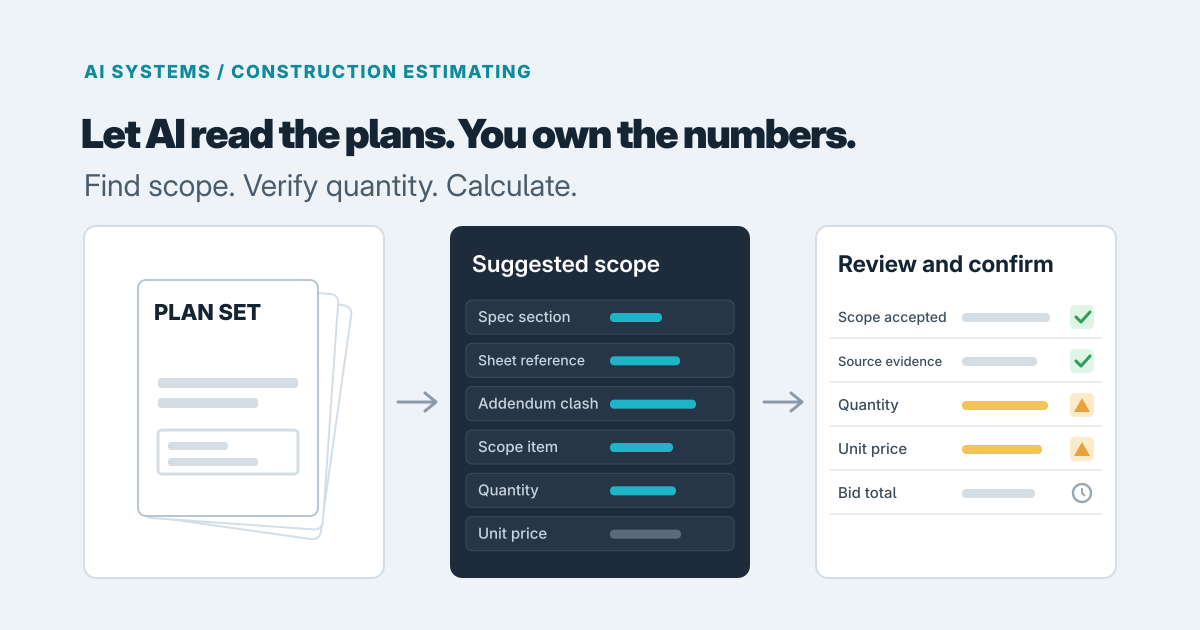
AI can help you read a plan set. It shouldn't set your quantities or your prices. That split decides whether an estimating tool saves your team time or quietly puts a wrong number into a bid.
The reason is how these models behave. In AECV-Bench, an academic benchmark of multimodal models on architectural and engineering drawings, text recognition and document question answering were the strongest areas, with accuracy up to 0.95. Counting doors and windows was often only 0.40 to 0.55, with sizable errors (AECV-Bench). The authors' summary is that models are better at reading a drawing than interpreting its geometry. That benchmark covers floor-plan counting, not full commercial sets, but the pattern matches what we would expect on a real bid.
Reading is a fit. Arithmetic isn't.
Think about what an estimator does with a plan set. Some of it is reading and interpretation: finding which spec sections touch your trade, catching a note on a detail sheet that changes the scope, spotting where an addendum contradicts a drawing, deciding which sheets matter at all. Some of it is counting and measuring. And some of it is arithmetic and judgment: applying waste, converting labor, adding tax, markup and margin, and deciding how much risk to carry.
A model is useful in the first group. It can read hundreds of pages of notes and specs, pull out candidate scope items, and flag conflicts for a person to look at. That's tedious work where a fast first pass is worth a lot.
The second group needs checking. Accuracy also drops when an answer depends on evidence from across a whole drawing set. LED-BENCH, a benchmark on large-format engineering drawings, found the best of 11 models averaged roughly half on its questions, and all did worse when the evidence was spread out (LED-BENCH). Those are question-answering tests rather than estimating, so treat them as a warning about direction, not a score for any product.
The third group shouldn't involve a model at all. Currency math is a rules problem. A language model that produces a plausible unit price is worse than no price, because it looks finished. Even a vendor that sells takeoff tools says AI can't decide how to handle risk, protect margin or price the way the work will actually be built (ConstructConnect).
Unknown must stay visible
The most dangerous failure isn't a wrong number you can see. It's a missing number that turns into zero, or a guessed number that looks like a measured one.
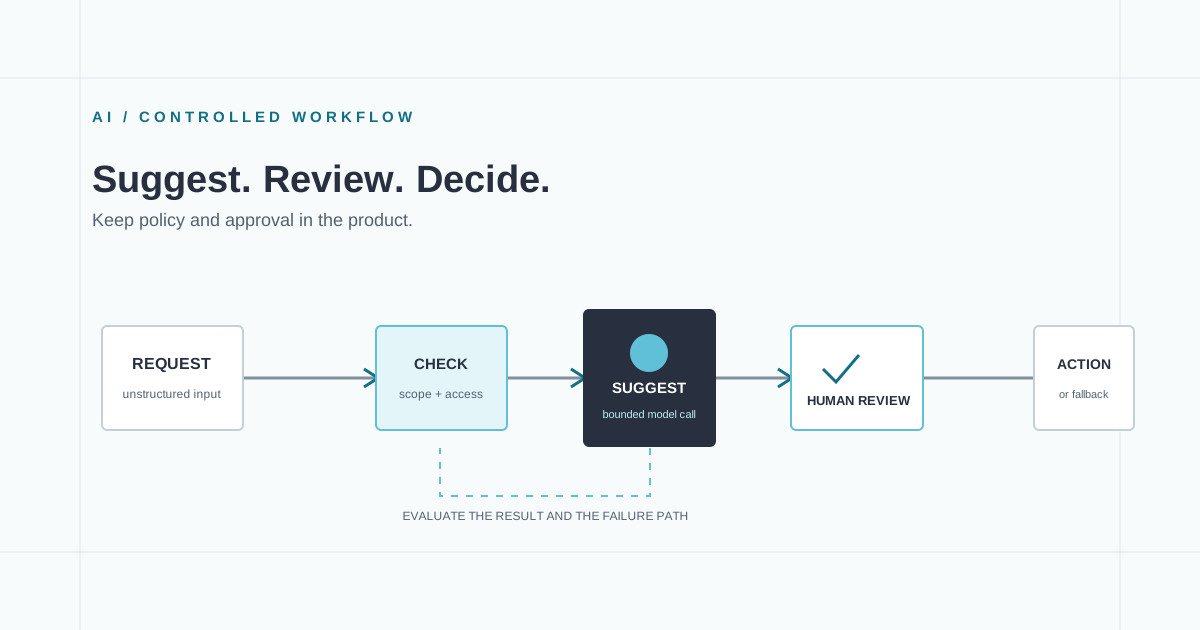
We would design around a simple rule: every quantity and price has a state, and an unknown quantity blocks the bid total until a person fills it in or explicitly excludes it. Nothing defaults. A reviewer should be able to see at a glance which lines are verified, which are suggested and which are still empty.
When reviewing AI output, estimators can look for wrong units, odd quantities, duplicate counts, missing counts and measurements that don't fit the plan. That list comes from the same ConstructConnect piece, which also advises confirming that all sheets and the latest addenda are present before anything else. Messy inputs matter too: low-resolution scans, handwritten markups and incomplete or conflicting sets all hurt accuracy.
Keep the evidence attached
A suggestion without a source is a chore, because the reviewer has to go find the proof. A suggestion that carries its sheet and region, or its spec paragraph, can be accepted or rejected in seconds.
So each suggested scope item should keep a pointer to where it came from, plus the reviewer's decision. Later, when someone asks why a line is in the bid, the answer is there. We'd rather have a tool that says "I found this on sheet A-201, check it" than one that says "here's your estimate."
Where Bidwright fits
When we built Bidwright, a construction estimating and proposal management application, we kept the cost math out of the model. Suggestions from AI are tied to their original evidence and reviewer decisions, and accepted scope still requires explicit quantity verification. Calculations for material waste, labor conversions, tax, markup, margin and cent reconciliation are deterministic, so a language model never invents a price. Unknown quantities and missing or unverified prices can't silently become trusted inputs.
Some limits matter. The public workflow and demonstration prices are synthetic, and contractors would supply and verify their own costs. Automatic drawing measurement, e-signatures, payments and accounting integrations are outside what's documented. We're not claiming results for any contractor.
Buy, build or wait
An off-the-shelf estimating add-on is probably enough if your plan sets are fairly clean and standard, and your cost data fits the tool's format. Don't build what you can rent.
Custom work starts to make sense when your assemblies, pricing logic or cost database are particular to your firm, or when the integration is the real pain. Some tools still need takeoff output loaded into an estimate template by hand (Palcode), and at least one needs manual mapping to export into a cost database or ERP (Miragemetrics). If that handoff is where your hours go, a tool that nails the reading step won't fix it.
Either way, test on your own work. Vendor accuracy claims of 95 to 99% are self-reported, and one vendor itself reports lower figures for phone photos of plans (Quotr). We'd read those headline numbers as best-case results rather than what your messier sets will produce, so ask for results on sets like yours, including scanned and revised ones.
Before starting, or before signing, we would do three things:
- Collect a handful of past bids with their final, verified takeoffs, so you have answers to measure against.
- Include your ugly sets: scans, addenda, conflicting sheets.
- Decide who reviews what, and how an unknown quantity gets resolved before a total appears.
If you don't have those examples yet, wait and build them first. They're useful whichever way you go.
If you're weighing a custom build, our AI applications and agents work is built around this kind of controlled, reviewed assistance. For the general boundary between model judgment and fixed rules, see where AI fits in an internal workflow. If your trouble is mostly pulling fields from PDFs, AI document processing for small businesses covers scoping around one document type. When you have sample bids and a specific question, get in touch and we can talk through whether a tool or a build fits.
Prepared with AI-assisted research and writing, with automated editorial checks before publication.