

A closer look at Mallace.
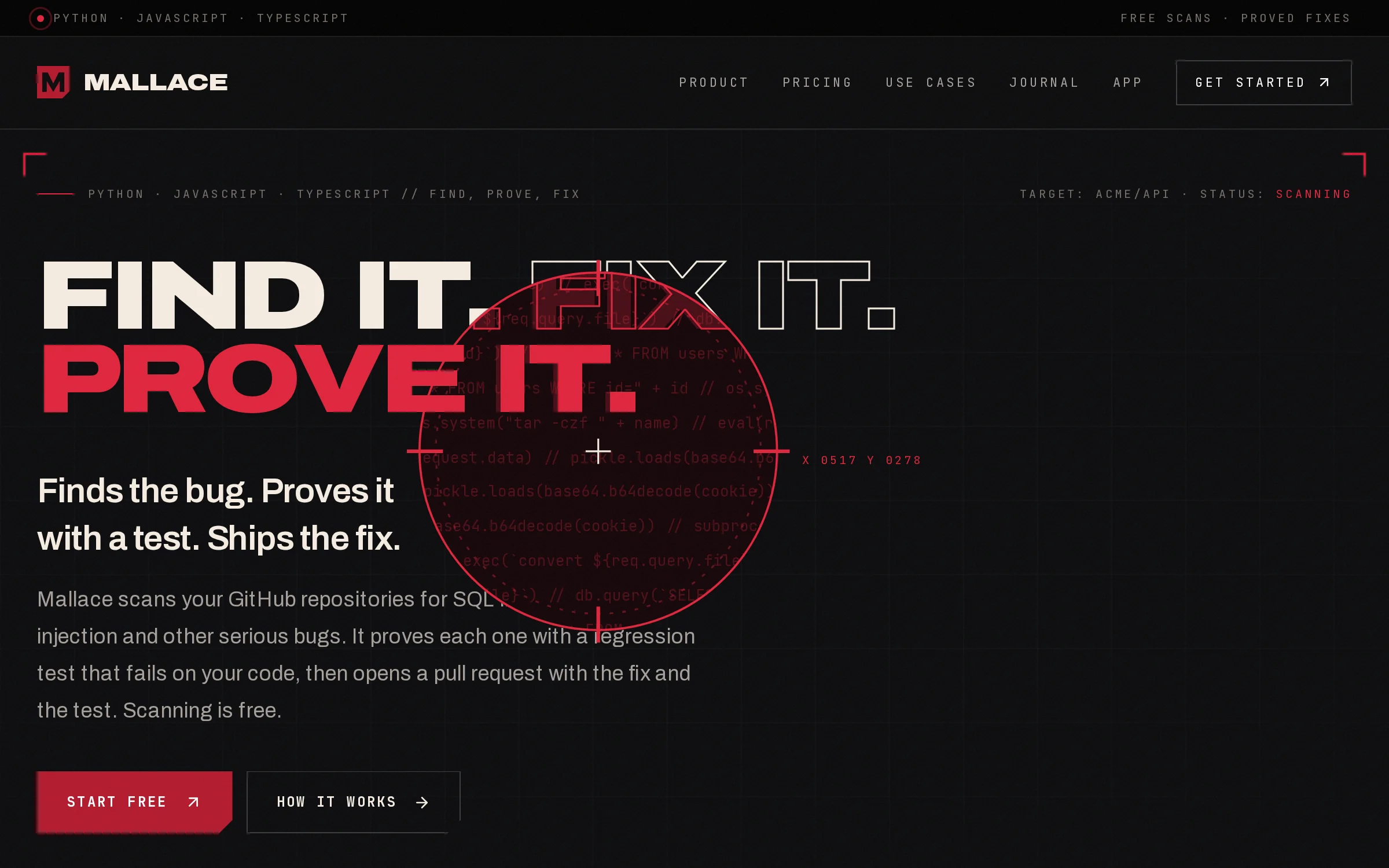
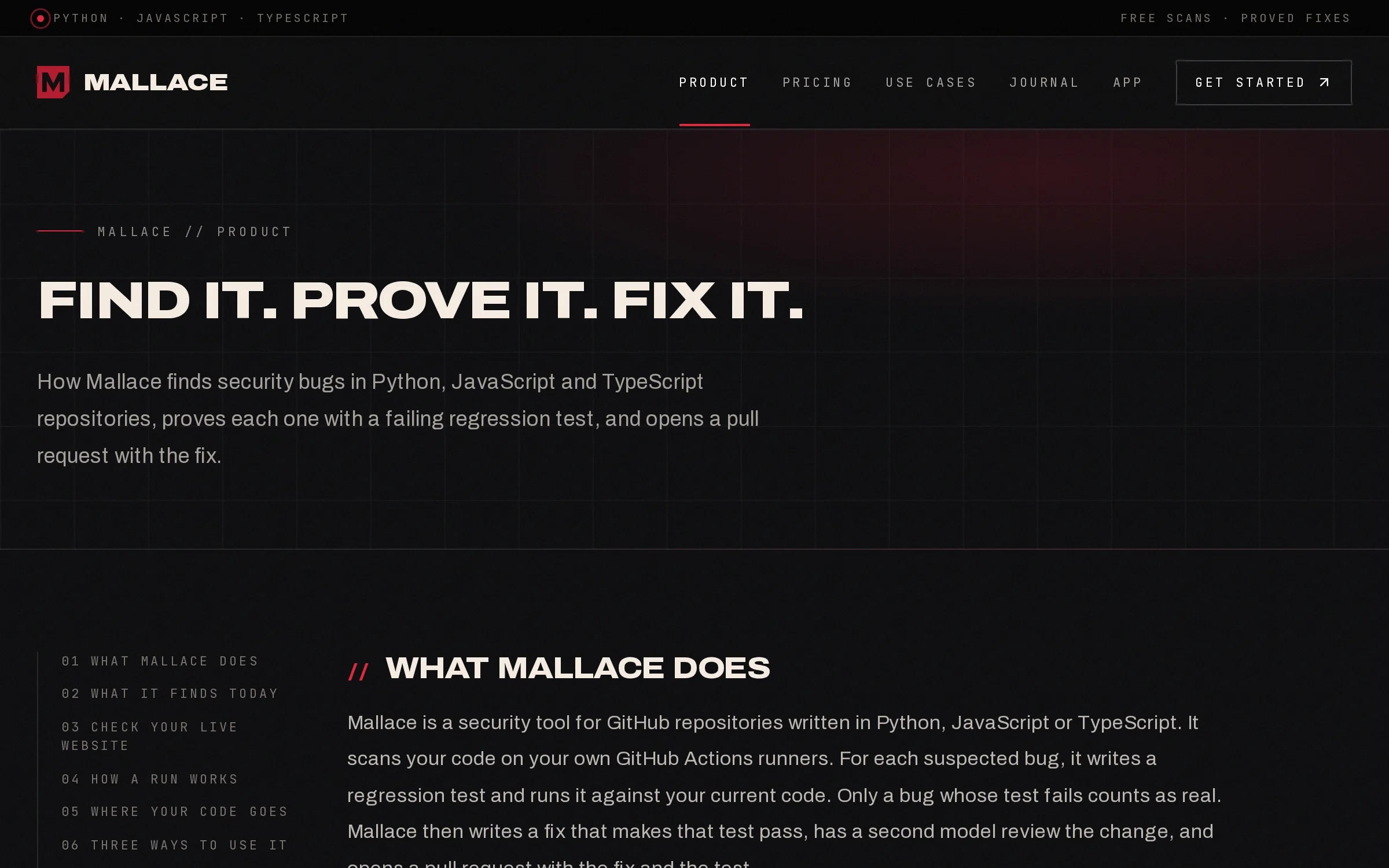
Mallace scans GitHub repositories written in Python, JavaScript/TypeScript, PHP or Ruby for SQL injection, command injection, code injection, unsafe YAML loading and unsafe deserialization, including Python pickle, PHP unserialize and Ruby Marshal. For each suspected bug it writes a regression test and runs it against the current code; only a bug whose test fails counts as real. It then writes a fix that makes the test pass, has a second model review the change, and opens a pull request containing both. Scanning is free, and nothing merges without the repository owner's review.
The challenge
Most security scanners stop at a report, leaving a team with a backlog of findings to triage and no proof that any one of them is real. A fix written without a test can also quietly come undone later. Small teams need the confirmed bugs fixed, with evidence that each fix works.
The product experience
A run scans the repository with a pinned, offline ruleset that follows caller-controlled data into dangerous calls. For each finding a model writes a regression test, which runs in a sandbox with no network; if the test passes, Mallace leaves the code alone. A model then writes the smallest fix it can, the same test has to pass, and a second, independent model reviews the change. Each verified fix becomes one issue and one pull request, explained in plain English. Every scan also reports leaked secrets and dependencies with known vulnerabilities, and a separate read-only check looks at a live website once its owner has proved ownership.
- A live product with three ways to use it: the Mallace app, a GitHub Action and a command-line tool.
- 17 rules across Python, JavaScript/TypeScript, PHP and Ruby, each proved by a failing regression test before any code changes.
- Free unlimited scanning, with a free plan and a paid Pro plan for fixes; no customer outcomes are claimed.
Product & engineering
Scanning and every test run happen on the customer's own GitHub Actions runner, or on their machine through the Python CLI, which uses Docker for the sandbox. To write a test, a fix or a review, only the code around that one finding goes to the Mallace service, with common credential formats redacted first; the service passes it to the AI model for that call and doesn't store it. A GitHub App limits access to the repositories the owner chooses. Dependency checks use the public OSV advisory database. Each run stops at a budget the owner sets or at the plan's monthly allowance, whichever comes first, and payments go through Stripe.
The decisions that shape the work
Proof before changes
No failing test, no fix. A finding whose test passes on the current code is reported as not reproduced, and the code is left alone.
The writer never approves its own fix
A second, independent model reviews each change against the finding, the test results and the original code. A rejected fix goes back for another attempt with the reviewer's feedback.
Keep code on the owner's runner
Scanning sends nothing anywhere. Fixes send only the code around each finding, and it is never stored.
Budgets that hold
Every run stops at the budget the owner sets and at the plan's monthly allowance, so AI costs stay predictable.
Working within the constraints
- Mallace covers a focused set of 17 rules across Python, JavaScript/TypeScript, PHP and Ruby. It doesn't scan other languages or infrastructure-as-code, and it doesn't open dependency upgrade pull requests.
- It isn't a full static-analysis platform, a penetration test or a compliance certification. The website check only looks at what any visitor can see; it doesn't attack.
- Tests and fixes are written by AI models, so every pull request needs human review. Nothing merges automatically.
- The GitHub Action is at version 0 and the CLI installs as a pre-release. No customer results or benchmark figures are claimed.
Have a similar challenge?
For small teams, startups and agencies with Python, JavaScript/TypeScript, PHP or Ruby code on GitHub who want confirmed security bugs fixed, with a test proving each fix.
Talk about your project